IPv4
From $0.72 for 1 pc. 38 countries to choose from, rental period from 7 days.
IPv4
From $0.72 for 1 pc. 38 countries to choose from, rental period from 7 days.
IPv4
From $0.72 for 1 pc. 38 countries to choose from, rental period from 7 days.
IPv6
From $0.07 for 1 pc. 13 countries to choose from, rental period from 7 days.
ISP
From $1.35 for 1 pc. 24 countries to choose from, rental period from 7 days.
Mobile
From $14 for 1 pc. 17 countries to choose from, rental period from 2 days.
Resident
From $0.49 for 1 GB. 200+ countries to choose from, rental period from 30 days.
 Armenia
 Australia
 Belgium
 Brazil
 Bulgaria
 Canada
 Czech
Czech
 England
 Estonia
 Finland
 France
 Germany
 Hong Kong
 India
India
 Indonesia
 Italy
Italy
 Japan
Japan
 Kazakhstan
 South Korea
 Latvia
 Lithuania
 Malaysia
 Mexico
 Netherlands
 Poland
 Portugal
 Romania
 Russia
 Singapore
 South Africa
 Spain
Spain
 Sweden
 Switzerland
 Thailand
 Turkey
 UAE
UAE
 Ukraine
 USA
USA
Use cases:
IPv4
From $0.72 for 1 pc. 38 countries to choose from, rental period from 7 days.
IPv6
From $0.07 for 1 pc. 13 countries to choose from, rental period from 7 days.
Armenia
Australia
Belgium
Brazil
Bulgaria
Canada
Czech
England
Estonia
Finland
France
Germany
Hong Kong
India
Indonesia
Italy
Japan
Kazakhstan
South Korea
Latvia
Lithuania
Malaysia
Mexico
Netherlands
Poland
Portugal
Romania
Russia
Singapore
South Africa
Spain
Sweden
Switzerland
Thailand
Turkey
UAE
Ukraine
USA
Use cases:
Tools:
Company:
About Us:
IPv4
From $0.72 for 1 pc. 38 countries to choose from, rental period from 7 days.
IPv6
From $0.07 for 1 pc. 13 countries to choose from, rental period from 7 days.
Armenia
Australia
Belgium
Brazil
Bulgaria
Canada
Czech
England
Estonia
Finland
France
Germany
Hong Kong
India
Indonesia
Italy
Japan
Kazakhstan
South Korea
Latvia
Lithuania
Malaysia
Mexico
Netherlands
Poland
Portugal
Romania
Russia
Singapore
South Africa
Spain
Sweden
Switzerland
Thailand
Turkey
UAE
Ukraine
USA
Business competitiveness directly depends on data quality, data accuracy, and freshness. A web scraping company helps systematize data capture and extraction, turning scattered information into a tool for forecasting, market assessment, and opportunity discovery. However, not every provider can guarantee reliability and alignment with business requirements. For more details on legal considerations, see Is Web Scraping Legal?
When choosing a partner, consider several factors: information quality and completeness, functionality, solution scalability, compliance with legal norms, level of technical assistance, and pricing. This approach will help identify the optimal solution and minimize risks when integrating these technologies into business processes.
It is the automated extraction and structuring of data from websites for subsequent analytics. Unlike manual copying, it provides fast and accurate processing of large information volumes through advanced web crawling mechanisms that interact even with complex websites containing dynamic elements or JavaScript-generated content.
For business, it’s useful in several key areas:
Using parsing provides clear advantages: time and resource savings, plus higher information quality. Timely access to market and competitor information helps companies react faster to changes and gain an edge.
Terms like “scraping”, “parsing”, and “data extraction” are often used interchangeably, though they refer to different layers of working with information.
Scraping is the automated collection of data from websites. It is responsible for retrieving content from online sources such as sites, marketplaces, and social networks.
Parsing is the next stage: analyzing and structuring already downloaded content (e.g., HTML) to extract specific information in a convenient format. Put simply, scraping collects the material, parsing processes it. For example, if you use ParseHub, integrating a proxy for ParseHub guarantees stable IP rotation and uninterrupted scraping of dynamic websites.
Data extraction is a broader concept that includes web scraping and parsing, as well as working with databases, APIs, PDF documents, Excel files, scanned materials, and other sources. It’s an end‑to‑end process of collecting, processing, and structuring information for analysis and decision‑making.
Thus, web scraping and parsing are complementary tools within the overall extraction workflow.
When choosing a data extraction services company, consider a set of criteria that determine solution effectiveness and reliability.
A reliable service offers parsing tools designed for both business teams and technical specialists.
A web scraping solution should support critical features that ensure stability, flexibility, and info quality:
Data scraping companies typically offer the following plans:
Evaluate pricing by the ratio of cost to value: feature set, support level, and hidden costs (overage, add‑on services). An optimal strategy is to test via a free trial or demo access.
A website scraping company should ensure validation, cleaning, and formatting to eliminate duplicates, noise, and irrelevant records. When choosing a vendor, consider their reputation, verified case studies, and willingness to provide sample datasets for testing.
Assess reliability during a trial: connection speed, response times, API stability, and proxy performance. Independent reviews and the provider’s reputation also matter.
Infrastructure scalability is critical as well: the service should handle traffic growth without performance loss. Companies with distributed server networks usually cope better with increased load.
A web scraping company should provide qualified technical assistance and regularly release updates and patches for its tools to maintain service relevance and security.
Support includes communication channels (chat, email), documentation, FAQs, and training materials. For enterprise customers, an SLA should define specific metrics: uptime, response times, and remediation timeframes.
A web scraping company must comply with legal requirements and industry standards, including personal data protection (GDPR, PII), secure information handling, and KYC policies.
It’s equally important to respect intellectual property, avoid parsing that infringes copyrights and trademarks, and to refrain from collecting confidential information without permission.
After defining scraping and parsing, their differences from other data‑collection methods, and the key criteria for selecting a provider, we can turn to examples. Below are companies that deliver strong results and are rightly considered market leaders.
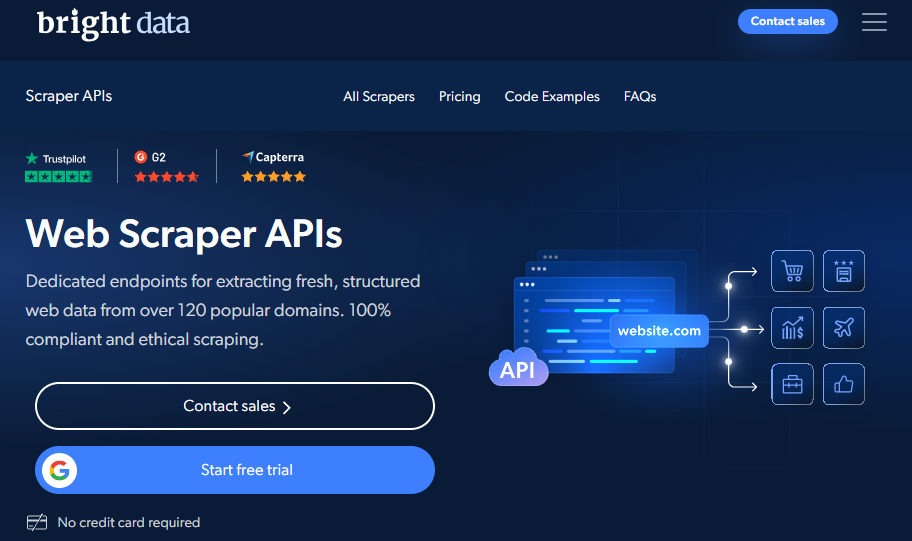
Web scraping company, offering scalable tools for accessing information from open sources. The flagship product is the Web Scraper API, an online tool that lets you call customizable endpoints and extract data even from protected sites. Compatibility with a mature proxy infrastructure ensures resilient requests and flexibility for large projects.
Key capabilities:
Data types: tables, JSON objects, raw HTML, text content, media assets, contact details, and metadata.
Saving/export: JSON and CSV export; upload to cloud storage (Amazon S3, Google Cloud Storage, Azure Blob), databases (Postgres, MySQL), FTP/SFTP, plus direct webhook delivery to ETL systems.
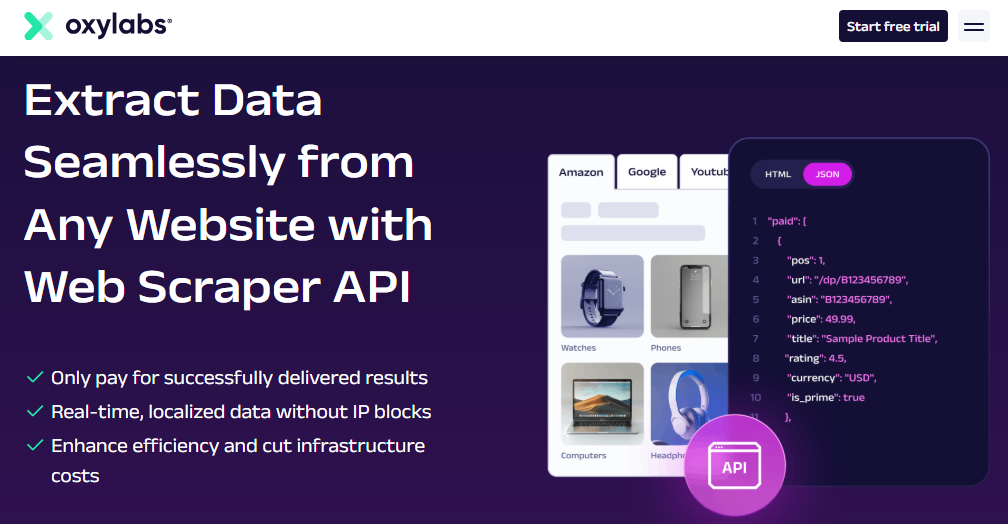
A leading web scraping company specializing in solutions for large‑scale collection and processing, as well as proxy infrastructure. The core product is the Web Scraper API, designed for automated parsing from sites of any complexity.
The platform supports rotating proxies, mitigation mechanisms, and JavaScript rendering, ensuring stable handling of dynamic sites. To boost efficiency, intelligent fingerprinting is applied.
The tool targets enterprise projects and supports OpenAPI, integration with modern pipelines, and AI‑based services–OxyCopilot and AI Studio–that simplify no‑code setup.
Key capabilities:
Data types: tables, JSON files, raw HTML, text and media elements, metadata.
Saving/export: JSON and CSV export; integration with cloud storage (Amazon S3, Google Cloud Storage, Azure Blob), database export, and webhook delivery.
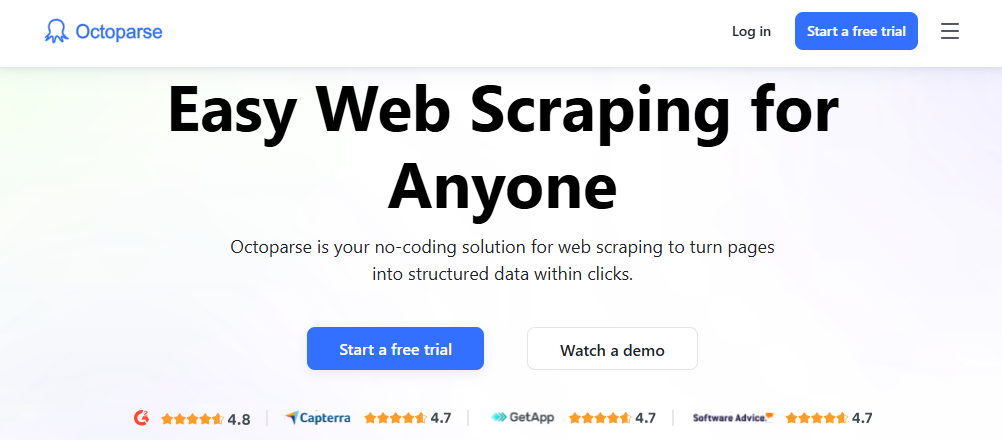
A desktop application for Windows and macOS built for non‑technical users who need structured information from web pages. The service stands out with a visual point‑and‑click builder that lets you configure extraction in a few steps. The program handles most technical scraping tasks automatically–from CAPTCHA handling and IP rotation to working with dynamic page elements. In addition to the local client, an online version is available to run jobs 24/7 and manage schedules.
Key capabilities:
Data types: text, tables, images, links, metadata, and other elements.
Saving/export: export to CSV, Excel, JSON, databases; save to the cloud or deliver via API.
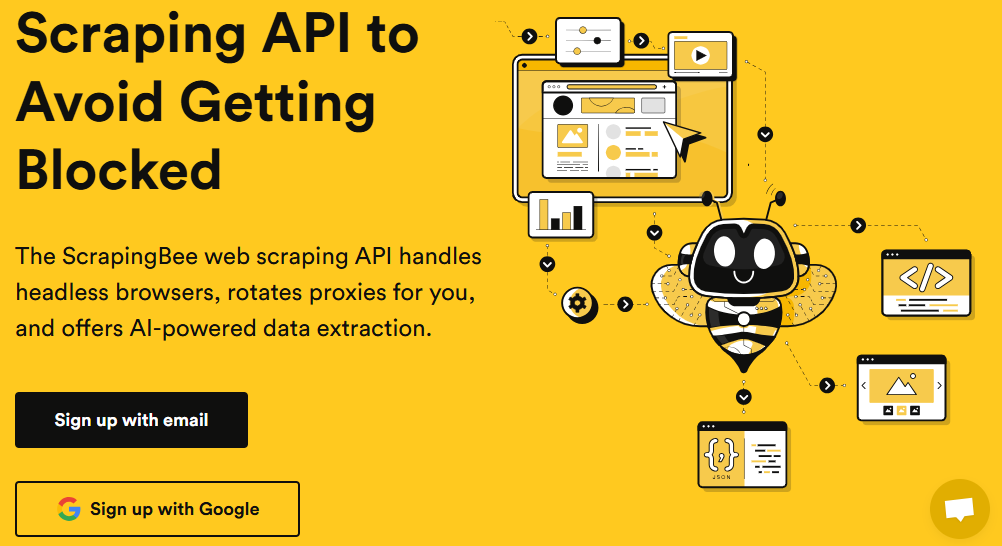
A premium‑class service aimed at developers who need a simple, universal programmatic interface for web extraction. The solution automatically manages a proxy pool and a headless browser, removing the burden of infrastructure setup and mitigation of technical limitations. Thanks to built-in anti‑bot handling and JavaScript rendering, the tool fits interactive resources and automation defenses.
Key capabilities:
Data types: raw HTML, JSON and XML, dynamic content loaded via XHR/AJAX.
Saving/export: export to HTML, JSON, and XML; delivery via HTTP clients; database integration.
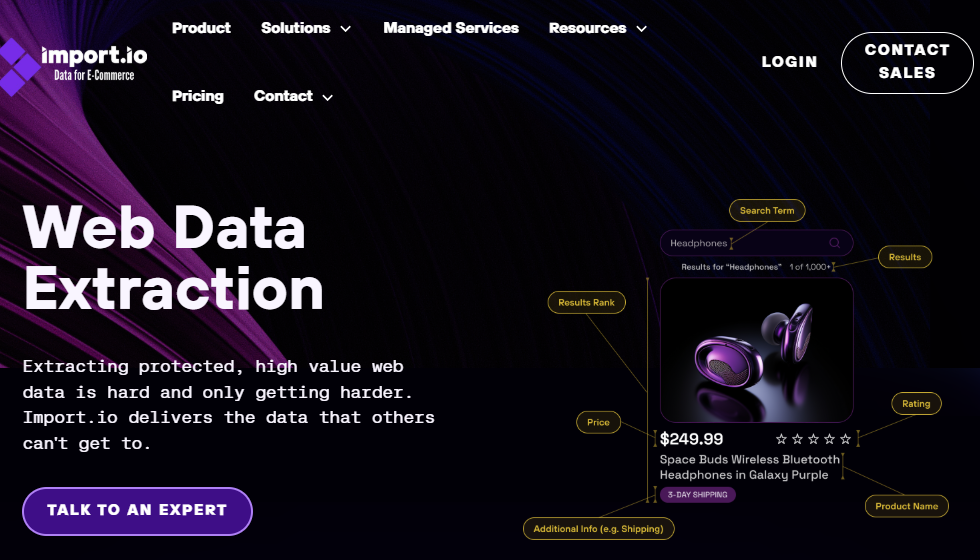
An online platform that converts web pages into structured information suitable for analytics, integration into business processes, and connection to external systems via REST API. No desktop installation is required because scraping tasks are created through a visual point‑and‑click interface.
The platform targets enterprise projects and provides stable access to information even from large and complex resources, simplifying scaling and integration into existing workflows.
Key capabilities:
Data types: structured tables and JSON objects, initial HTML.
Saving/export: export via API; CSV, Excel, JSON, and other formats; integration with external systems.
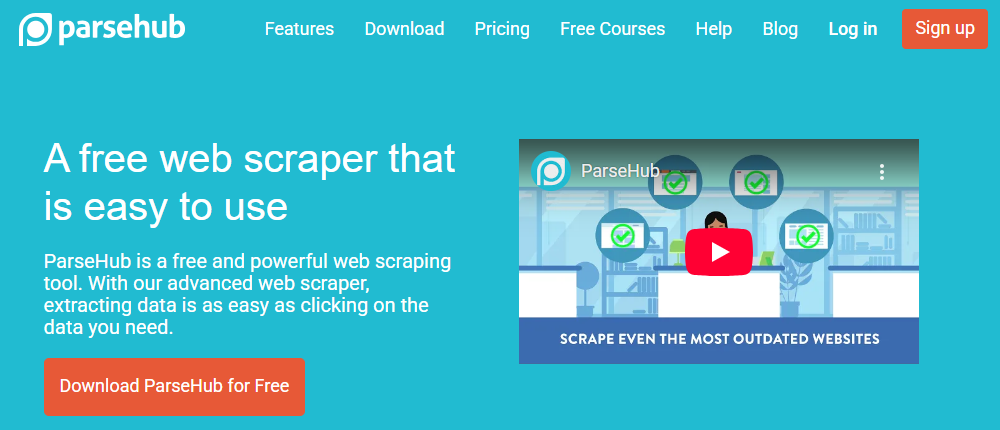
A desktop application for scraping aimed at users without programming skills. Tasks are configured through a point‑and‑click interface: open the target site in a browser, select elements to extract, and define the export format. The solution supports interactive resources, including pages with JavaScript content, and provides automatic IP rotation. Alongside the local client, the service offers an online platform for launching and scheduling tasks in real time.
Key capabilities:
Data types: tables, text blocks, HTML attributes.
Saving/export: export to CSV and JSON; storage on ParseHub Cloud; integration with Amazon S3 and Dropbox; delivery via REST API.
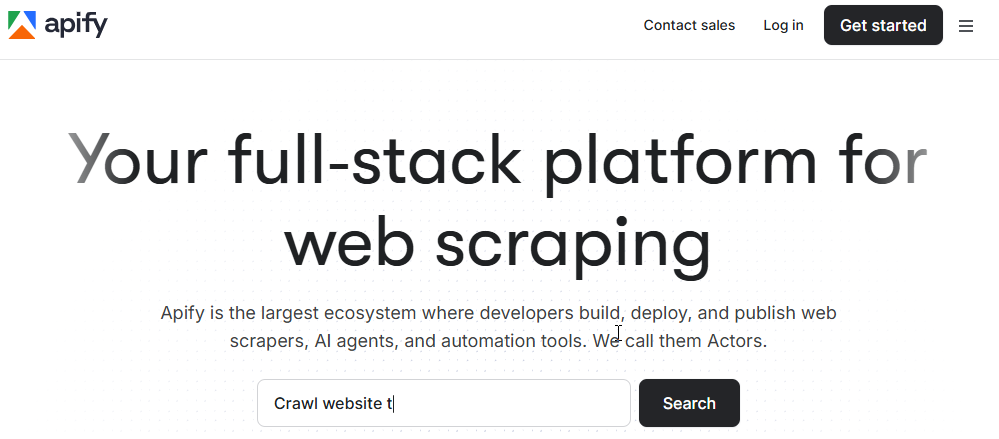
A cloud platform for scraping and building custom parsers. The service supports both user scripts in Python and JavaScript and a library of ready‑made solutions–more than 1,500 templates. The core idea of Apify is to turn any site into an API and ensure stable extraction of required elements.
Key capabilities:
Data types: JSON, CSV, Excel, HTML pages, text blocks, and metadata.
Saving/export: export to CSV, JSON, Excel; upload to cloud storage, databases, or delivery via API.
To make it easier to compare the capabilities of the services listed above, the table below summarizes their key differences.
| Web Scraping Company | Tool | Functions | Price | Free Version | OS | Integrations |
|---|---|---|---|---|---|---|
| Bright Data | API | Scalable infrastructure, IP rotation, JS and CAPTCHA support, data validation, webhooks | From $499/month | Yes | Windows, macOS, Linux | Any languages and HTTP clients, parsing libraries |
| Oxylabs | API | Automatic IP and user-agent rotation, JS rendering, CAPTCHA bypass, AI Studio, batch requests | From $49/month | Yes | Windows, macOS, Linux | LangChain, Selenium, Playwright, Python, Java, Node.js, and more |
| Octoparse | Desktop and Cloud Versions | No-code, templates, cloud automation, IP auto-rotation, AI assistant | From $69/month | Yes | Windows, macOS | Zapier, Google Drive, Google Sheets, Airtable, Slack, Salesforce, and more |
| ScrapingBee | API | Automatic JS execution, antibot bypass, geotargeting, API scheduling, JSON/XML export | From $24/month | Limited | Windows, macOS, Linux | Any HTTP clients and parsing libraries |
| Import.io | Cloud Version | Visual builder, cloud-based launch, no-code, CAPTCHA, scheduling, notifications | From $399/month | Yes | Windows, macOS, Linux (browser) | REST API, export to CSV/JSON/Excel, third-party libraries |
| ParseHub | Desktop and Cloud Versions | No-code, support for dynamic sites, scheduling, XPath/RegEx, REST API | From $189/month | Yes | Windows, macOS, Linux | ParseHub Cloud, Dropbox, Amazon S3, REST API |
| Apify | Cloud Version | Ready-made templates, JS/Python scripts, Crawlee, antibot bypass, proxies | From $39/month | Yes | Windows, macOS, Linux | Google, GitHub, Gmail, Asana, Zapier, and others |
Modern collection tools are versatile platforms for extracting and processing information, valued by individual specialists and large enterprises alike. Key market players–Bright Data, Oxylabs, Octoparse, ScrapingBee, Import.io, ParseHub, and Apify–offer various operating models: from enterprise‑grade cloud APIs with AI support and ready‑made templates to desktop applications that require no programming.
The main advantage of these solutions is reliable, scalable access to information, streamlined structuring, and accelerated decision‑making. When selecting a tool, align the choice with your goals and project scale: for high‑volume processing and deep integration, consider Bright Data, Oxylabs, ScrapingBee, and Import.io; for fast business tasks without technical preparation, Octoparse, ParseHub, and Apify are convenient options.
Yes, when data collection is performed within the law. Reliable companies use official site APIs when available, avoid infringing copyrights, and do not collect personal information without user consent.
Services handle load differently. For example, Bright Data provides full control: pause settings, request limits, IP rotation, and geotargeting. ScrapingBee also supports rate control but with less granular management. Octoparse, Import.io, and ParseHub rely on built-in delay settings without advanced ban‑avoidance logic.
Octoparse and ParseHub can automatically adapt to DOM changes and offer visual editors for selectors. Apify and Import.io allow adding custom rules and scripts. ScrapingBee and Bright Data emphasize stable APIs, which may require manual adjustments when significant changes occur.
Bright Data and Oxylabs provide large proxy pools with rotation, allow User-Agent management (learn more here), and support geotargeting. In ScrapingBee, IPs and headers are changed automatically. Apify lets you integrate third‑party proxies and anti‑detect scenarios. Octoparse, Import.io, and ParseHub use basic IP rotation without complex anti‑detect mechanisms.
 Instagram
  Facebook
  TikTok
  Telegram
  YouTube
  Twitter
  Reddit
  LinkedIn
  Runescape
  Dofus
Dofus  Metin2
  Silkroad
  Margonem
  Minecraft
  Lineage 2
  WoW
WoW  Lords Mobile
  Travian
  Steam
Steam  Origin
  Google
  ScrapeBox
  Amazon
  Ebay
Ebay  Shopify
  Etsy
Etsy  Netflix
  Spotify
  Twitch
  Browsing