IPv4
From $0.72 for 1 pc. 38 countries to choose from, rental period from 7 days.
IPv4
From $0.72 for 1 pc. 38 countries to choose from, rental period from 7 days.
IPv4
From $0.72 for 1 pc. 38 countries to choose from, rental period from 7 days.
IPv6
From $0.07 for 1 pc. 13 countries to choose from, rental period from 7 days.
ISP
From $1.35 for 1 pc. 24 countries to choose from, rental period from 7 days.
Mobile
From $14 for 1 pc. 17 countries to choose from, rental period from 2 days.
Resident
From $0.49 for 1 GB. 200+ countries to choose from, rental period from 30 days.
 Armenia
 Australia
 Belgium
 Brazil
 Bulgaria
 Canada
 Czech
Czech
 England
 Estonia
 Finland
 France
 Germany
 Hong Kong
 India
India
 Indonesia
 Italy
Italy
 Japan
Japan
 Kazakhstan
 South Korea
 Latvia
 Lithuania
 Malaysia
 Mexico
 Netherlands
 Poland
 Portugal
 Romania
 Russia
 Singapore
 South Africa
 Spain
Spain
 Sweden
 Switzerland
 Thailand
 Turkey
 UAE
UAE
 Ukraine
 USA
USA
Use cases:
IPv4
From $0.72 for 1 pc. 38 countries to choose from, rental period from 7 days.
IPv6
From $0.07 for 1 pc. 13 countries to choose from, rental period from 7 days.
Armenia
Australia
Belgium
Brazil
Bulgaria
Canada
Czech
England
Estonia
Finland
France
Germany
Hong Kong
India
Indonesia
Italy
Japan
Kazakhstan
South Korea
Latvia
Lithuania
Malaysia
Mexico
Netherlands
Poland
Portugal
Romania
Russia
Singapore
South Africa
Spain
Sweden
Switzerland
Thailand
Turkey
UAE
Ukraine
USA
Use cases:
Tools:
Company:
About Us:
IPv4
From $0.72 for 1 pc. 38 countries to choose from, rental period from 7 days.
IPv6
From $0.07 for 1 pc. 13 countries to choose from, rental period from 7 days.
Armenia
Australia
Belgium
Brazil
Bulgaria
Canada
Czech
England
Estonia
Finland
France
Germany
Hong Kong
India
Indonesia
Italy
Japan
Kazakhstan
South Korea
Latvia
Lithuania
Malaysia
Mexico
Netherlands
Poland
Portugal
Romania
Russia
Singapore
South Africa
Spain
Sweden
Switzerland
Thailand
Turkey
UAE
Ukraine
USA
When deploying large language models to users, enterprise developers pay huge API fees and experience unexpected downtime. An LLM proxy serves as a middleman between client apps and AI engines, helping manage costs. This tutorial covers how these middleware systems handle incoming traffic and optimize latency for enterprise data streams in real time.
An LLM proxy is an AI gateway. It is a smart middle layer between your apps and AI API providers (OpenAI, Google, Anthropic). Rather than having each application contact an AI provider directly, all of your requests are funneled through a single gateway.
Consider it a traffic controller.
Teams use it for control and consistency. It's inconvenient when every app has to have its own safety checks, keys, and logs. With LLM middleware, you get policy control and a safer deployment.
The diagram below reflects the logic of how it works: requests from your applications pass through internal caching, data protection, and monitoring tools before reaching the end providers.
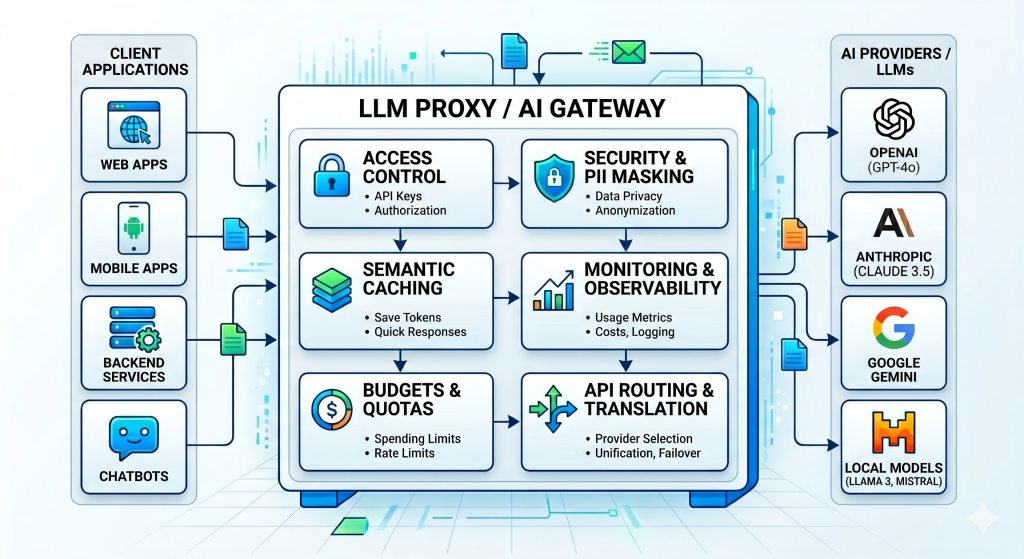
How it works in practice:
The following is a list of key features of the AI gateway:
The main advantages of this architecture are the following:
An LLM middleware can redact PII, removing names, phone numbers, etc., and replacing them with placeholders. This makes sure nothing sensitive gets into third parties’ hands. This processing helps to ensure compliance with standards, including GDPR and CPPA, when using public cloud APIs.
You can also set up rate limiting to stop unauthorized employees from making too many calls in a short time. With role-based access control (RBAC), you can restrict access to the pricier models to only those who need them. It’s about compliance, but it’s also about having a safe, well-governed environment against external threats.
A self-hosted deployment is preferred by many organizations that want absolute control of local data flow. Teams can deploy an open source LLM proxy on their own cloud setup. For maximum control, enterprises prefer to use a private proxy from the best proxy providers to keep all traffic within the company, which closely aligns with strict data residency and privacy rules.
For a self-hosted configuration, for example, all the traffic from the internal apps will flow through an API gateway and all the traffic from the outside will flow through a reverse node. Use them both and you'll have governance in one place.
LLM configuration solutions can be:
Let's see an example of a customer support bot which calls the OpenAI Python (with the base URL):
from openai import OpenAI


client = OpenAI(
    base_url="https://llm-proxy.internal/v1",   # Point to the proxy
    api_key="team-support-key"
)
response = client.chat.completions.create(
    model="gpt-5.5-thinking",
    messages=[{"role": "user", "content": "Where is my order #123?"}]
)
In LiteLLM or using custom YAML:
general_settings:
  master_key: os.environ/PROXY_MASTER_KEY


model_list:
  - model_name: gpt-5.5-thinking
    litellm_params:
      model: openai/gpt-5.5-thinking
      api_key: os.environ/OPENAI_API_KEY


litellm_settings:
  drop_params: true
  set_verbose: true


router_settings:
  routing_strategy: "usage-based"


  # enable rate limiting
  enable_rate_limiting: true
  global_max_rpm: 1000


guardrails:
  - type: pii_redaction
    entities: ["CREDIT_CARD", "EMAIL", "PHONE_NUMBER"]


fallbacks:
  - primary: gpt-5.5-thinking
    fallback: gpt-5-thinking-mini
    timeout: 2s
We set PII redaction (to hide the credit card, email, phone number), rate limiting (to limit to 1,000 requests/min), and fallbacks (to reroute to GPT-5 Thinking Mini in the event of a 2s delay). If necessary, you can write a custom routing rule. For all AI data collection tools, a similar mechanism will work where dedicated proxies for ScrapeBox (or another scraper) would also handle redaction and logging of all requests.
Let's explore a couple of situations:
Service abstraction/unified API. If you have already written your code for some version of the SDK (like OpenAI's), then you will need to write the integration logic again to get it to work with Anthropic's Claude product.
A proxy provides one endpoint to the client (typically the same structure as the OpenAI API). All that is required is to replace an AI engine or provider in the proxy server configuration – there are no lines of code in the application that are to be replaced.
Audit logs & observability. There are dozens of microservices based on AI, however it is hard to have control of what they are eating and consuming.
A proxy gathers all the metrics throughout the company: how many tokens have been used, what the latency is, what prompts the users enter, etc.
Failover & fallback logic. Any AI provider can "crash" or return an error because of overload (code 429 - Too Many Requests).
When a user's request to the primary AI system (such as GPT-5.5 Instant) fails with an error, the proxy automatically and seamlessly redirects the request to the backup AI system (such as Claude Sonnet 4.6), or to a different region/account.
In either case, a multi-model approach takes place. It splits tasks into simple (text classification, spam detection) and complex (coding, analyzing financial reports, architectural planning). Simple tasks are given to small and cheap versions (Llama 3 8B or GPT-4o-mini). More complex tasks are channeled to the more expensive engines (Claude Opus 4.8).
Such a strategy avoids spending money on a large (expensive) model when handling simple tasks.
Businesses that have generative apps greatly benefit from an LLM proxy. They reduce operational costs and protect enterprise data streams by managing them all in one place (centralized management). For those who are interested in the longer-term evolution of AI, please contact us to discuss how we can enable you to do that through our infrastructure.
 Instagram
  Facebook
  TikTok
  Telegram
  YouTube
  Twitter
  Reddit
  LinkedIn
  Runescape
  Dofus
Dofus  Metin2
  Silkroad
  Margonem
  Minecraft
  Lineage 2
  WoW
WoW  Lords Mobile
  Travian
  Steam
Steam  Origin
  Google
  ScrapeBox
  Amazon
  Ebay
Ebay  Shopify
  Etsy
Etsy  Netflix
  Spotify
  Twitch
  Browsing