IPv4
From $0.50 for 1 pc. 38 countries to choose from, rental period from 7 days.
IPv4
From $0.50 for 1 pc. 38 countries to choose from, rental period from 7 days.
IPv4
From $0.50 for 1 pc. 38 countries to choose from, rental period from 7 days.
IPv6
From $0.07 for 1 pc. 14 countries to choose from, rental period from 7 days.
ISP
From $1.35 for 1 pc. 23 countries to choose from, rental period from 7 days.
Mobile
From $15 for 1 pc. 17 countries to choose from, rental period from 2 days.
Resident
From $0.70 for 1 GB. 200+ countries to choose from, rental period from 30 days.
 Armenia
 Australia
 Belgium
 Brazil
 Bulgaria
 Canada
 China
China
 Czech
Czech
 England
 Finland
 France
 Georgia
 Germany
 Hong Kong
 India
India
 Indonesia
 Italy
Italy
 Japan
Japan
 Kazakhstan
 Korea
Korea
 Latvia
 Lithuania
 Malaysia
 Mexico
 Netherlands
 Poland
 Portugal
 Romania
 Russia
 Singapore
 South Africa
 Spain
Spain
 Sweden
 Switzerland
 Thailand
 Turkey
 Ukraine
 USA
USA
Use cases:
Armenia
Australia
Belgium
Brazil
Bulgaria
Canada
China
Czech
England
Finland
France
Georgia
Germany
Hong Kong
India
Indonesia
Italy
Japan
Kazakhstan
Korea
Latvia
Lithuania
Malaysia
Mexico
Netherlands
Poland
Portugal
Romania
Russia
Singapore
South Africa
Spain
Sweden
Switzerland
Thailand
Turkey
Ukraine
USA
Use cases:
Tools:
Company:
About Us:
Armenia
Australia
Belgium
Brazil
Bulgaria
Canada
China
Czech
England
Finland
France
Georgia
Germany
Hong Kong
India
Indonesia
Italy
Japan
Kazakhstan
Korea
Latvia
Lithuania
Malaysia
Mexico
Netherlands
Poland
Portugal
Romania
Russia
Singapore
South Africa
Spain
Sweden
Switzerland
Thailand
Turkey
Ukraine
USA
Geo targeting advertising remains one of the most effective ways to reach narrowly defined audiences. According to Global Growth Insights, brands that actively use location data see up to a 45% increase in engagement and about a 36% uplift in CTR thanks to more accurate impressions.
However, in practice specialists often encounter a different picture: ads are delivered to the wrong users and in the wrong areas, which leads to lower geographic accuracy, broken segmentation, and wasted budget.
This happens because location detection depends not only on the settings in the ad account, but also on IP address, carrier data, GPS, and Wi-Fi. Any disruption in these signals can cause regional ads to show in another district or with incorrect geo attributes. These issues become especially noticeable in the mobile segment, where signals change many times throughout the day.
Industry statistics show that around 39% of companies see discrepancies in geodata across platforms, while projects that operate in several coverage zones at once lose on average about 34% of their effectiveness due to geo mismatches.
To get a realistic picture of impressions and reliable analytics, specialists increasingly rely on proxy servers, which let them emulate access from a specific city and run full-fledged creative tests.
This article explains what is geo-targeting in advertising and how it works, why errors occur, and how intermediaries improve the accuracy, stability, and performance of multi-region marketing, conversion tracking, and campaign scaling.
When a user visits a site or opens an app, the website evaluates location signals and decides whether the user matches the configured geographic filters.
1. Location-based geotargeting
Precise selection of a country, city, region, or radius around a point is the classic “by location” geotargeting model. Restaurants, delivery services, retailers, and offline businesses use it for tightly localized campaigns. Its strength is simplicity, while its weakness is a strong dependence on how accurate the IP signal is.
2. Behavioral geo targeting advertising
Here the platform analyzes where a person regularly spends time — at home, at work, at school. This type of targeting works well for longer funnels and campaigns with extended decision cycles, but it performs worse for tourists and people on the move, where audience segmentation by real presence becomes less reliable.
3. Mobile geo targeting advertising
Such geotargeting relies on GPS, Wi-Fi, and carrier data. It is the most precise but also the most unstable method, because these signals may change many times over the course of a day. A common issue specialists face is “jumping” between districts and inconsistent accuracy indoors vs outdoors, where different data sources dominate.
To determine a user’s actual location, ad systems combine several independent data sources to improve accuracy:
Any major company (Google, Meta, TikTok) relies on this same bundle of signals, applying its own internal weighting and logic.
The decision chain for determining location typically looks like this:
Understanding how geotargeting in advertising actually works is critical for those who want to manage reach deliberately, rather than adapt to platform errors.
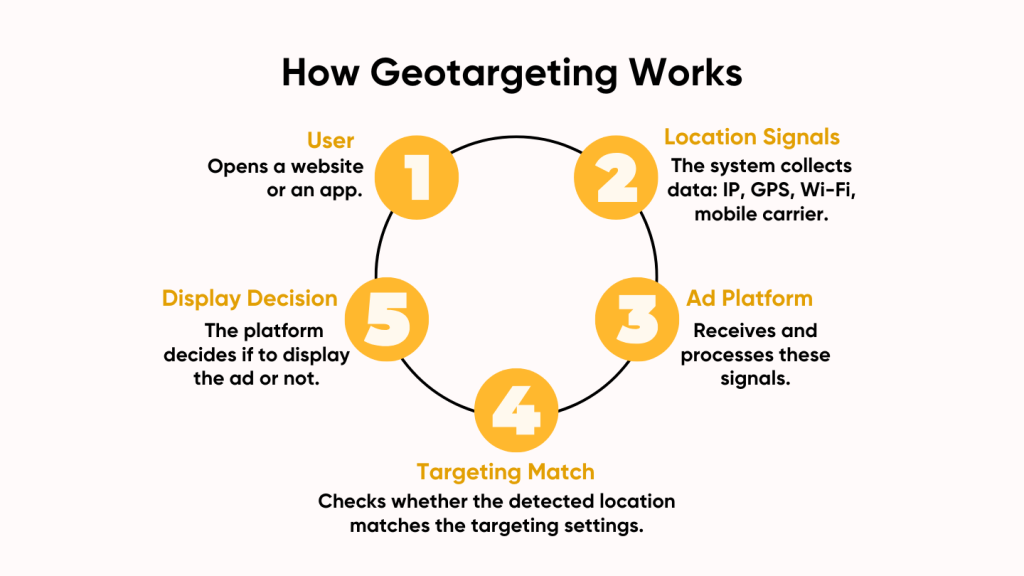
Even though websites rely on multiple signals to determine location, the algorithms still misfire. The core reason is that most location data is not a precise coordinate but an indirect signal, which can be distorted or misinterpreted.
When a user enables a VPN, their IP gets replaced, and the system treats them as residing in a completely different region. BigDataCloud estimates that a 1% drop in IP-geolocation accuracy at a $1M budget and a $10 CPM shifts about 1M impressions between correct and incorrect geography. This clearly illustrates how VPNs and masking tools distort geotargeting, burn budget on irrelevant users, and weaken campaign performance.
Sometimes the infrastructure itself introduces geotargeting errors. A CDN may serve content through a server in another part of the country, and complex traffic routing can easily confuse ad platforms. ContentHurricane notes that in such scenarios the budget may be spent on impressions in neighboring coverage zones, while the intended region receives fewer or no impressions.
With CG-NAT, a single public IP may be shared among thousands of users across different cities, which inevitably undermines geographic accuracy. For example, if an operator maps a subscriber in Lyon to an IP registered in Paris, the ad platform will treat the user as being in Paris, even though the person is physically in Lyon.
Public networks such as airport or café Wi-Fi often use shared or “anonymized” egress points that do not match where the user actually is. Because of this, localization of ads becomes distorted, leading to unnecessary budget losses.
Privacy controls also directly affect accuracy. According to Global Growth Insights, about 59% of users feel uncomfortable with continuous tracking of their whereabouts, roughly 48% have already turned off geodata access for some apps, and 44% demand stronger control over their personal data. As a result, algorithms often work with partial or heavily truncated geographic signals, which increases the likelihood of geotargeting errors.
Geolocation issues manifest differently across ad ecosystems:
Geo targeting advertising in Meta becomes more accurate when GPS or Wi-Fi is available, but when only IP is present, noticeable shifts are common. Media buyers often see that Meta’s estimated potential reach does not match the real geographic distribution of users, which complicates planning and reporting.
Google uses a specific approach: it targets not only by physical presence in the area, but also by “interest” in it. This means that people who recently searched for information about a region may see the ads even if they are physically elsewhere. In such cases, compliance with advertising rules becomes harder, especially in regulated verticals or when strict local restrictions apply.
TikTok relies heavily on the IP signal. If the network address is determined incorrectly or the device uses a mobile network with CG-NAT, TikTok may assign the user to a different city or even another country, which seriously disrupts geotargeting for local campaigns.
In real-world campaigns, geo targeting advertising alone doesn’t always provide the required accuracy, so specialists add proxy infrastructure to regain control over location-dependent delivery.
Even if the company claims that ads are running in the selected coverage zone, this still does not guarantee that
To verify these points, you need intermediaries. They allow specialists to check directly how the promoted content looks to a user in a given city or region, without relying solely on platform reports.
Such intermediaries let a specialist “move” into the target region virtually and verify that:
Without this approach, you only test advertising indirectly through platform reports, which may fail to reflect the real situation on the ground.
If different countries or cities use tailored creatives or pricing, it is critical to confirm they are rendered correctly, because companies might select the wrong creative due to IP errors or conflicting behavioral signals. Proxies allow manual checks of how each variation appears in specific target zones, down to the city or neighborhood level.
For large advertisers and arbitrage teams operating in dozens of territories, intermediaries become a key operational tool. With them you can:
Such traffic is highly unstable: IPs change frequently, GPS jumps, Wi-Fi may resolve to neighboring districts, and the carrier may assign a single public address to several users. Using intermediaries helps you verify:
For such initiatives where geotargeting directly shapes CPA and lead quality, these checks are especially critical.
Some marketing tools restrict access or functionality for certain territories. When configured properly, proxies restore access to full functionality, help avoid false “suspicious activity” flags, and enable testing of ad strategies without unnecessary risk of bans. They also improve the reliability of performance metrics and analytics, making geo targeting advertising behavior more predictable and transparent for the team managing these activities.
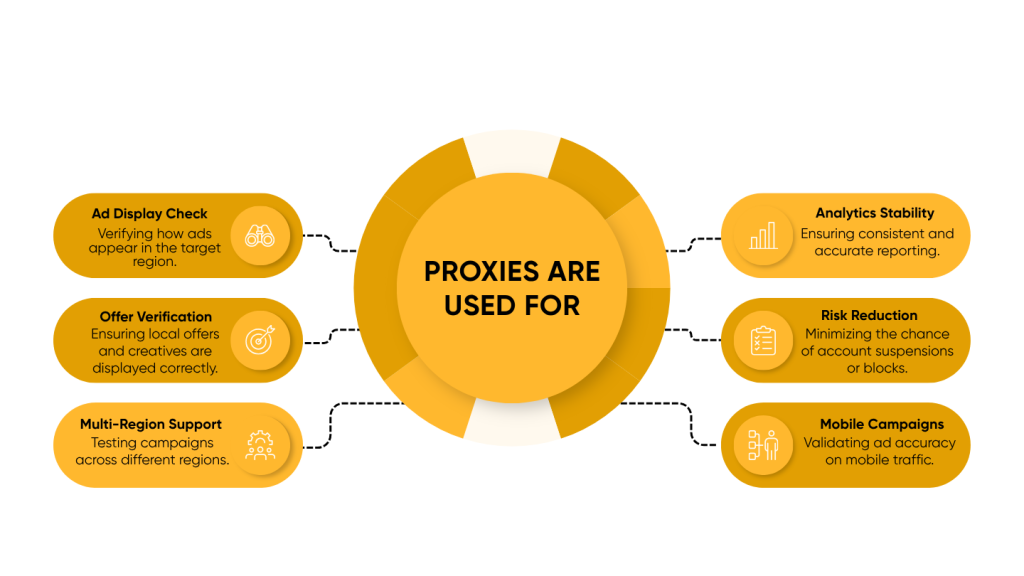
You cannot fix location-based targeting errors solely with ad-account settings. Problems often arise at the level of the carrier, routing, connection address, or user behavior. Below are complementary practices that help maintain impression quality and reduce distortions.
Choosing the correct type directly affects stability and campaign performance, because each category of intermediary solves its own specific tasks.
They route traffic through mobile network operators, so ad platforms perceive them as natural user connections. This makes them especially useful for:
Why this works:
Such IP type matches the traffic profile that platforms expect to see, which reduces error risk and improves geo targeting advertising quality.
These use connections from home ISPs, which makes them suitable for:
checking geo-bound offers,
testing localized language versions,
ad verification — inspecting what a real user actually sees.
Why this works:
This connection type looks like a normal home broadband link, which provides more realistic checks of ad delivery and reduces suspicion from Meta or TikTok, both of which may limit accounts when they detect non-user traffic.
They cost less, but they are a poor fit for production ad accounts, because algorithms easily identify them as non-user traffic.
Why they are a weak option:
Meta and TikTok may restrict delivery, increase CPM, or exclude part of the audience when they detect datacenter IPs. Teams use them mainly for bulk technical checks, not for tasks that require accurate geographic binding such as full-scale geo targeting advertising.
Proxy types and when to use them
|
Type |
Best suited for |
Stability |
Risks |
Where not to use |
|---|---|---|---|---|
|
Mobile |
TikTok, Meta, mobile campaigns |
high |
Higher cost per IP |
— |
|
Residential |
Offer checks, localization, ad verification |
high |
Occasional platform-side restrictions |
— |
|
Datacenter |
Purely technical tasks and bulk diagnostics |
medium |
Block risks, higher CPM, distorted delivery |
Meta/TikTok ad accounts |
For real geotargeting and account work, you usually want mobile or residential IPs, while datacenter solutions serve as auxiliary infrastructure. Proper selection directly influences accuracy and stability, so before launching ads, decide how to choose a proxy type that matches each advertising initiative’s objectives.
To confirm that geo targeting advertising behaves correctly:
This workflow shows how the ad system actually interprets your geographic scope. If targeting is misconfigured or misread, the company may serve your ads to the wrong audience, which dramatically reduces overall efficiency of your paid media.
Rotation means changing the network address at defined intervals. This is useful in two main scenarios:
1. Monitoring delivery stability
If you have 10 different IPs in the same city, rotation helps you test:
2. Emulating different user profiles
Changing the connection point simulates different users, which helps you understand:
Rotation prevents platforms from treating test activity as coming from a single user, while also showing how geotargeting behaves in a variety of conditions.
To keep the signal “clean,” your IP should align with:
For example, if the system detects a connection from Hamburg but the time zone is set to Kyiv, Meta or TikTok may limit account functionality or degrade delivery quality. Consistent regional settings help avoid these artificial flags and keep campaigns stable.
Specialized tools like Identory simplify work with:
This software normalizes device fingerprint, behavioral patterns, and other metadata that could reveal the true geography of the session. Combined with intermediaries, this setup generates more natural-looking traffic and makes geo targeting advertising behavior more predictable.
Even if impressions are served correctly, you still need to confirm that analytics are tied to the right geography:
Intermediaries allow you to trace the entire chain from impression to conversion as a real user would: ad view → click → target action → recorded event for the correct city in analytics.
For large-scale campaigns spanning multiple territories, it is helpful to:
This approach reduces the risk of incorrect delivery, prevents currency and language mix-ups, minimizes audience overlap, and lowers the likelihood of restrictions from ad platforms.
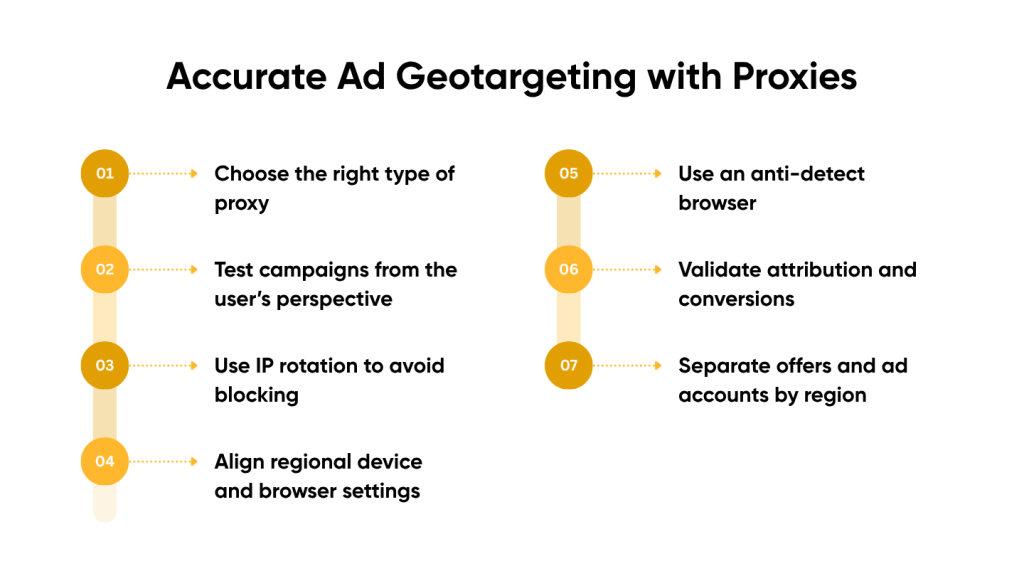
Geotargeting in advertising remains a core performance-marketing tool, yet it is also one of the main sources of budget loss and skewed analytics. The underlying reason is straightforward: ad platforms make location decisions based on unstable signals — IP, GPS, Wi-Fi, and carrier data, and any failure can lead to the wrong users seeing your ads, shifted geography, or misallocated reach. Consequently, regional analytics and conversion tracking become distorted.
Intermediaries help identify and compensate for these issues. They give the company one stable and consistent location signal, so specialists can observe campaign results the same way a real user in the target city would see them, rather than through the platform’s sometimes-inaccurate interpretation.
Typical geolocation errors and how intermediaries help detect them
|
Error |
Why it occurs |
Which proxy type helps |
|---|---|---|
|
CG-NAT |
Many users share the same public IP, making it impossible to pinpoint the city or area accurately. |
Mobile or residential ones provide a unique ISP-grade IP and pass a correct access point signal to the website. |
|
Public Wi-Fi |
Shared or anonymized connections do not reflect where the user is actually connecting from. |
Dedicated residential solutions look like a home connection from a specific individual. |
|
VPN |
VPN replaces the address with another country or region, which corrupts geo data. |
Mobile or residential IPs in the desired city/country restore trustworthy geo signals. |
|
GPS jumps |
The device moves, switches networks, or loses signal, and coordinates “jump” between points. |
Mobile ones emulate stable traffic and smooth out sudden changes. |
|
CDN routing |
Content is served through a server in a different sector, which misleads geography detection. |
Residential options pass a correct IP from the target city and compensate for routing-related shifts. |
Proxies act as a control layer for traffic quality, geotargeting accuracy, and trustworthy analytics. To maximize their impact, it is essential to choose them correctly:
When these conditions are met, your paid media are far more likely to be served exactly where and how they were configured, and 4G/5G and residential solutions – including those from Geonix – become a practical way to select the right region and ad format quickly and reliably.
In most cases, the issue lies not in the ad account configuration but in how the website interprets location signals. To diagnose this, test geo targeting advertising through a proxy with an IP in the target city and verify that creatives are localized correctly. Additionally, check delivery from several IPs in the same region to rule out platform-level routing or technical errors.
They simulate presence in any city, allowing you to see the ad feed and search results exactly as a local user would. This lets you:
The most reliable choice is 4G/5G or residential solutions with granular city-level targeting in the campaign’s region. For TikTok and Meta, connections from operators usually work best, while home-ISP residential IPs are optimal for checking websites and local offers. When choosing, pay attention to exit-point stability, actual provider ranges, and the ability to rotate multiple addresses within one territory.
They let you view competitor ads in specific cities, analyze local offers, impression frequency, creatives, and geographic bindings for their campaigns. This helps you borrow effective approaches, adjust your own bids and segmentation, and find regions where competitors are ramping up their presence.
Risks appear mainly when the wrong IP types are used. Datacenter ones, for example, may raise suspicion on ad platforms, cause delivery restrictions, or distort results. A new IP with an incorrect region can also produce misleading conclusions. To avoid these issues, use mobile and residential solutions with accurate geo-binding and a consistent device fingerprint that matches the connection’s geography.
 Instagram
  Facebook
  TikTok
  Telegram
  YouTube
  Twitter
  Tinder
  Reddit
  LinkedIn
  Runescape
  Dofus
Dofus  Metin2
  Silkroad
  Margonem
  Minecraft
  Lineage 2
  WoW
WoW  Lords Mobile
  Travian
  Steam
Steam  Origin
  Google
  ScrapeBox
  Amazon
  Ebay
Ebay  Shopify
  Etsy
Etsy  Netflix
  Spotify
  Twitch
  Browsing